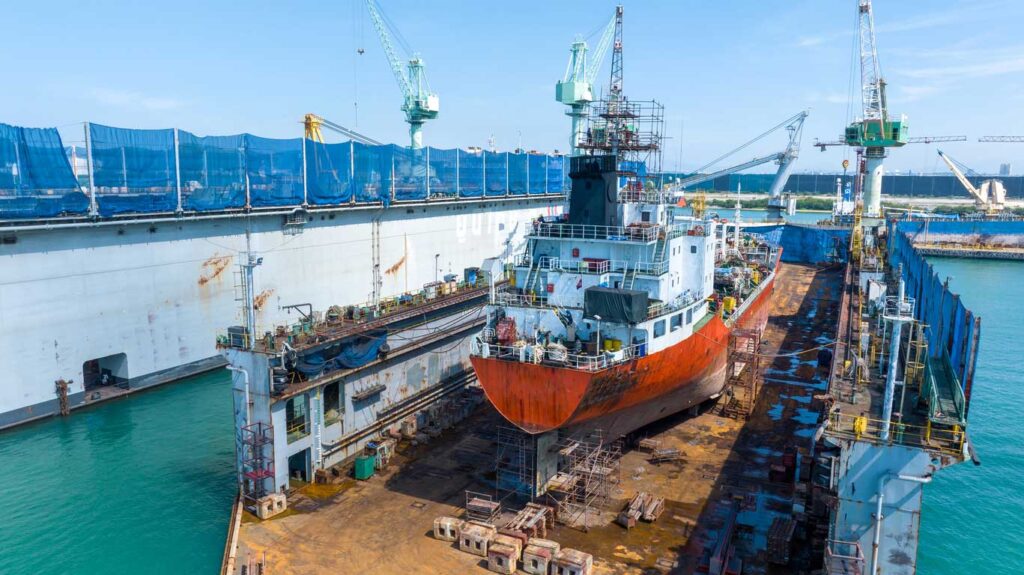
Asian shipbuilding: The politics behind the success
Asia dominates the global shipbuilding industry – yet low wages only partly explain this success. Government loan guarantees, targeted subsidies and an industrial policy coordinated over decades are the decisive factors. A look at Japan, South Korea and China shows that it is not just the construction of the ships, but above all their financing and the purchasing process that are the key to market leadership.
Table of contents
- Asian shipbuilding: The politics behind the success
- What are the political factors behind the success of the Asian shipbuilding industry?
- What are the risks involved in buying a boat?
- Why is Asia’s leadership role no coincidence?
- How did Japan become a shipbuilding nation?
- What role did the Korean War play?
- How did this cycle of costs and exports come about?
- How did South Korea and China replicate the model?
- Why is the purchasing process the most important policy lever?
- How does the state credit system work?
- What does this mean for the European shipbuilding industry and its skilled workers?
- Enquire about skilled shipbuilding workers from Eastern Europe
- Frequently asked questions
Estimated reading time: 9 minutes
What are the political factors behind the success of the Asian shipbuilding industry?
Shipbuilding does not begin at the shipyard, but with a customer’s decision to commission a ship. This is precisely where the state industrial policy of many Asian countries comes into play: it makes it easier for shipping companies to access finance and reduces the financial risks associated with major new-build projects.
This is crucial, as buying a vessel is a complex and costly process. Large capital outlays, insurance, technical requirements, legal regulations and subsequent operating costs must all be calculated before the order is placed. Government loans, guarantees and support schemes can significantly lower these barriers, thereby creating a competitive advantage for domestic shipyards.
What are the risks involved in buying a boat?
Buying a ship is a long-term investment running into millions. Shipping companies must be able to trust that the ship is technically reliable, meets all legal and insurance requirements, and can be operated profitably.
These factors make the ordering process complex: construction costs, delivery times, financing, insurance, technical standards and subsequent operating costs all play a key role. The government can step in to provide support here – for example, through loan guarantees, subsidy schemes or guarantees. In doing so, it assumes or mitigates part of the financial risk and makes it easier for shipping companies to decide to commission a newbuild.
Why is Asia’s leadership role no coincidence?
In the case of the Asian countries that currently lead the global shipbuilding industry, this leading role is by no means a coincidence. It is the result of a careful, politically driven process, the outcomes of which are now becoming apparent. Government strategies, as well as cooperation between businesses, banks and the political sphere, play a key role in this.
Since the 1990s, governments in Asia have been actively intervening in the planning and expansion of local shipbuilding capacity. In doing so, they have been pursuing a far-reaching industrial and geopolitical strategy.
How did Japan become a shipbuilding nation?
In the case of Japan, this strategy was based on a simple approach. Before and during the Second World War, Japan was not yet fully industrialised; at the same time, further industrialisation efforts remained limited. This was due, amongst other things, to constant rivalry between the naval and land forces, which led to a fragmentation of efforts and enterprises. The result was that production was often carried out by hand and was consequently labour-intensive and slow.
During the Second World War, US attacks devastated the Japanese merchant and naval fleets, as well as large parts of the country. Industry, which was dependent on imports, lay in ruins. The merchant and naval fleets had largely been sunk. What could happen next?
What role did the Korean War play?
From the US perspective, it was important to prevent a communist takeover by promoting Japan’s market-based economy and industrial development. The Korean War led to the targeted use of Japanese shipyards for the repair of damaged vessels. This provided the Japanese shipbuilding industry with funding, experience and the opportunity to develop new skills; together, these factors accelerated its development into a modern and efficient industrial sector.
How did this cycle of costs and exports come about?
Government support gave the Japanese shipbuilding industry a strong starting position. In addition, the government supported the shipyards through direct funding programmes and export assistance.
This created a self-reinforcing cycle: more favourable financing and lower costs made exporting easier. Rising export figures led to higher production volumes, greater experience and additional technical capacity. This drove costs down further – and the shipyards were able to offer even more ships on the world market.
How did South Korea and China replicate the model?
To this day, this model continues to dominate the Asian shipbuilding industry. South Korea and China adopted this model and supported their industries with substantial state subsidies. Added to this is the establishment of state-controlled or state-affiliated conglomerates, such as Hyundai Heavy Industries and Hanwha Ocean. These are designed to ensure that the government retains control over this sector of the economy.
Whilst low labour costs are now cited as the reason for the success of shipbuilding in Asia, it was in fact political will and government strategies that brought about this success. For the nations concerned, this involved vital issues such as international trade, jobs for their people and the ability to defend themselves at sea.
Why is the purchasing process the most important policy lever?
The key focus of government support lies in the purchasing process. Without orders, there can be no shipbuilding: shipyards do not build ships to stock, but to order. It is therefore essential to make construction contracts as financially viable and predictable as possible for shipping companies.
Japan supports this process with government loan guarantees. In this way, the government assumes part of the financial risk associated with building a ship. This reduces the risk for shipping companies of having to finance large investments on their own.
The Japanese model is based on the country’s substantial foreign exchange reserves. These enable the government to secure loans on favourable terms and to provide guarantees against potential financial shortfalls. This makes new construction in Japan more attractive: the government acts as an additional guarantor for the financing.
How does the state credit system work?
Guarantees from the Japanese government are essential. Purchasing or ordering a ship is a costly undertaking and, as an investment, carries considerable risk. Private banks do not normally lend hundreds of millions of euros or dollars without government guarantees.
Japan has, from its own perspective, resolved this problem by using political institutions to mitigate the financial risk. In other words, the politically facilitated credit system is the main reason for Japan’s position as a market leader in shipbuilding.
In the case of South Korea and China, both countries apply exactly the same principles: state-owned banks guarantee the loans and thus assume, at least in part, the risk involved in ordering a ship.
What does this mean for the European shipbuilding industry and its skilled workers?
Whilst Asia excels in state funding and mass production, the strength of the European shipbuilding industry lies in specialisation, innovation and quality. This strength stands or falls on the availability of skilled workers – and this is precisely where it is worth looking to Eastern Europe. Experienced skilled workers from Poland, the Czech Republic and Romania are filling staff shortages and bringing solid craftsmanship to modern, digitalised production environments.
Welder & CNC operator
Precision work in specialist engineering and component manufacturing
Electricians & Electronics Technicians
Control, safety and navigation technology
Mechanics & Industrial Mechanics
Drive and Energy Systems
Pipe fitters & pipework installers
Supply and Fuel Systems
Shipbuilder & Steelworker
Fuselage and section construction, structural work
Enquire about skilled shipbuilding workers from Eastern Europe
Do you want to stand out from the international competition through innovation and quality, and need the right skilled workers to achieve this? We recruit experienced welders, electricians, mechanics and shipbuilders from Poland, the Czech Republic, Romania and other EU countries – quickly, in full compliance with the law and with the right qualifications.
Frequently asked questions
Why does Asia dominate the global shipbuilding industry?
It is not just low wages that are decisive, but above all political will and an industrial policy that has been coordinated over decades. Governments, banks and shipyards work together to make buying a ship as straightforward and low-risk as possible for customers.
How did government policy help Japan to develop its shipbuilding industry?
After the Second World War, Japanese shipyards benefited from repair contracts linked to the Korean War. This brought in revenue, experience and new technical skills. In addition, the Japanese government supported the industry with funding programmes and export subsidies. This created a self-reinforcing cycle of rising order volumes, growing expertise and falling costs.
What is the most important instrument of state support?
The most important factor is the financing of the ship purchase. Japan supports the export of ships through, amongst other things, public export credits, insurance and guarantees. This reduces part of the financial risk for shipping companies and the banks providing the finance.
Why are government loan guarantees so crucial?
Building a ship often costs several hundred million euros and involves high risks. Private banks usually only finance such projects if repayment is adequately secured. Government guarantees and export credits can provide this security and thus help secure orders for domestic shipyards. They were a key factor in Japan’s rise in the shipbuilding industry.
What prospects remain for the European shipbuilding industry?
Europe excels through specialisation, innovation and quality rather than mass production. This strength depends largely on a skilled workforce. Placing experienced EU staff can help to address staff shortages in European shipyards and supplier companies.
What is the legal procedure for seconded EU staff?
As a general rule, EU citizens enjoy the free movement of workers. However, in the case of a posting, the applicable social security, employment and registration requirements must be observed. In many cases, this includes the A1 certificate and the necessary registrations. In the case of temporary agency work, compliance with the Temporary Agency Work Act (AÜG) must also be ensured. We take care of all the necessary steps, depending on the specific circumstances, fully and at no extra cost to you.
Do you need shipbuilding subcontractors on a contract basis instead of temporary labour? Our sister platform takes care of that zeitarbeit-international.de.
Similar topics